
Personal Finance, Investment Management, and Financial Planning -- What Works and What Does Not Work
My Value to You -- Personalized Scientific Financial Planning Services
Our Objective Family Finance Blogs
Subscribe to OUR OBJECTIVE FAMILY FINANCE BLOGS
OR Enter your email address & get our FREE ARTICLES directly


Main Menu
Read These Popular Articles on Our Family Finance Blogs:
Login
Username:

Password:


Lost Password?

Register now!
SmartSection is developed by The SmartFactory (http://www.smartfactory.ca), a division of INBOX Solutions (http://inboxinternational.com)


Quicken and VeriPlan Comparison:  Expenses and Savings

In this series of short articles, The Skilled Investor compares the functionality of the Quicken and VeriPlan financial lifecycle planners. At the bottom of this article you will find links to the previous topic and the next topic. A link is also provided that returns you to the main topic listing of this comparison.*

VeriPlan Personal Financial Lifecycle Planner

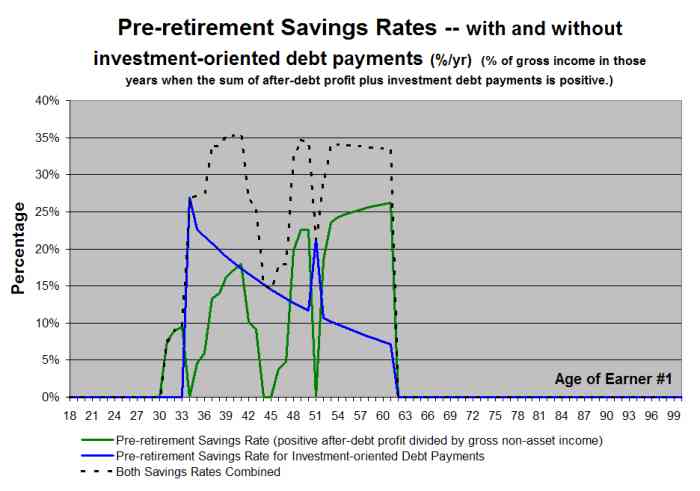
VeriPlan's Expense and Savings tool allows you to change your current expense levels and future expense growth rates. It also allows you to enter major planned expenses and their growth rates in any future year. You can enter positive and negative expense adjustments and growth rates for any projection year. VeriPlan fully automates the savings projection process and relates savings to annual net income after taxes and debt payments.  (See:  VeriPlan helps you to understand your lifetime personal savings requirements and whether you current savings rate is sufficient)

You need to enter you total current living expenses into VeriPlan, less your taxes and mortgage payments, which are managed elsewhere in VeriPlanautomatically. VeriPlan is not a current expense tracking application. VeriPlan assumes that you may already use some current expense tracking method, such as a personal spreadsheet or an expense tracking application like Quicken or MSMoney. 

VeriPlan provides instructions on how to develop quickly an appropriate total measure of your annual living expenses from the information that you already have in your current expense tracking application. If you do not track your current expenses, you can simply use an annual estimate. However, VeriPlan will also strongly encourage you to begin some method of current expense tracking on a monthly or quarterly basis to increase your control over current savings.

Quicken Retirement Planner

The Quicken Retirement Planner provides some expense projection functionality that is similar to VeriPlan's. Because Quicken is an expense tracking application, the Quicken Retirement Planner has been integrated. To enter expenses into the Quicken Retirement Planner you can select from your current expense category details elsewhere in Quicken, or you can use a rough estimate of your current total annual expenses. 

The Quicken Retirement Planner requires the user to set an arbitrary planned saving percentage, while VeriPlan fully automates this savings projection process. The Quicken Retirement Planner's expense and inflation adjustment data entry process uses a series of dialog boxes. 

<< Previous Topic

* Lawrence Russell and Company is the publisher of The Skilled Investor and the developer of VeriPlan. The Skilled Investor has made an attempt to characterize factually the functionality of both the Quicken Retirement Planner and VeriPlan.
________________________________________________________  
SCROLL DOWN FOR LINKS TO OTHER ARTICLES IN THIS CATEGORY

  View this article in Adobe Acrobat PDF format Print article Send article

Other articles in this category
The Quicken and VeriPlan Lifetime Financial Planners - Comparison Topics Index
Quicken and VeriPlan - A Comparison Introduction and Overview
Quicken and VeriPlan - User Interface and Data Entry Comparison
Quicken and VeriPlan - Projection Graphics and Data Comparison
Quicken and VeriPlan - Inflation Comparison
Quicken and VeriPlan - Navigation Comparison
Quicken and VeriPlan - User Documentation Comparison
Quicken and VeriPlan - Current and Future Debts Comparison
Quicken and VeriPlan - College and Other Education Costs Comparison
Quicken and VeriPlan - Expenses and Savings Comparison
Quicken and VeriPlan - Estate Planning Comparison
Quicken and VeriPlan - Financial Decision Tools Comparison
Quicken and VeriPlan - Home Purchase Planning Comparison
Quicken and VeriPlan - Human Capital Comparison
Quicken and VeriPlan - Income Comparison
Quicken and VeriPlan - Investment Overview Comparison
Quicken and VeriPlan - Asset Classes and Asset Allocation Comparison
Quicken and VeriPlan - Asset Class Returns Comparison
Quicken and VeriPlan - Investment Cost Comparison
Quicken and VeriPlan - Portfolio Rebalancing Comparison
Quicken and VeriPlan - Portfolio Risk Comparison
Quicken and VeriPlan - Portfolio Safety Comparison
Quicken and VeriPlan - Retirement Overview Comparison
Quicken and VeriPlan - A Comparison of Retirement Contributions to Tax-advantaged Retirement Plans
Quicken and VeriPlan - A Comparison of Optimizing Your Tax-Advantaged Retirement Plans over Your Lifecycle
Quicken and VeriPlan - A Comparison of Retirement Income including Social Security Pensions and Annuities
Quicken and VeriPlan - Tax Overview Comparison
Quicken and VeriPlan - A Comparison of Capital Gains Taxes and Asset Tax Basis
Quicken and VeriPlan - Federal State and Local Personal Income Tax Comparison
Quicken and VeriPlan - A Comparison of Tax Filing Status Dependents Adjustments and Deductions
Quicken and VeriPlan - Real Estate and Property Tax Comparison
Quicken and VeriPlan - Systems and Performance Comparison
Quicken and VeriPlan - User Satisfaction Guarantee Comparison
Quicken and VeriPlan - Tutorials Comparison
Quicken and VeriPlan - Product Licensing and Purchase Comparison
Quicken and VeriPlan - Product Obsolescence Comparison
The comments are owned by the poster. We aren't responsible for their content.
Poster Thread