
Personal Finance, Investment Management, and Financial Planning -- What Works and What Does Not Work
My Value to You -- Personalized Scientific Financial Planning Services
Family Finance Blogs
Do-It-Yourself Personal Financial Planning
Main Menu
Read These Popular Articles on Our Family Finance Blogs:
Login
Username:

Password:


Lost Password?

SmartSection is developed by The SmartFactory (http://www.smartfactory.ca), a division of INBOX Solutions (http://inboxinternational.com)


Quicken and VeriPlan Comparison:  Estate Planning 

In this series of short articles, The Skilled Investor compares the functionality of the Quicken and VeriPlan financial lifecycle planners. At the bottom of this article you will find links to the previous topic and the next topic. A link is also provided that returns you to the main topic listing of this comparison.*

VeriPlan Personal Financial Lifecycle Planner

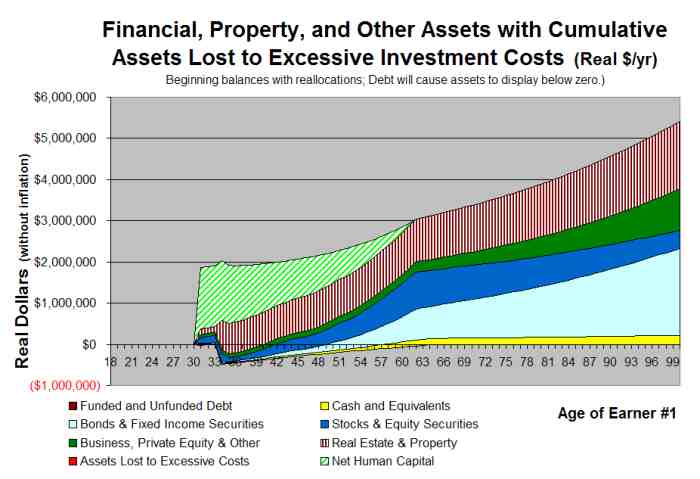
For every projection year through age 100, VeriPlan provides a breakdown of projected assets in the five main asset classes (see: Quicken and VeriPlan Comparison:  Investments - Overview). VeriPlan provides year-by-year projections of financial assets in taxable, traditional tax-deferred, and Roth tax-advantaged accounts. In essence, VeriPlan's asset projection graphics and data sheets provide the projected value of the family estate (before estate taxes) in every projection year, as if one person might die in that year.  (See:  VeriPlan helps you to project the potential size of your estate in future years)

However, proper estate planning requires a competent estate lawyer. VeriPlan does not attempt to project the intricacies of estate values beyond the death of either person. VeriPlan always develops plans that assume full planned living expenses for both people through age 100 in the event that they were both to live that long. By analyzing VeriPlan's graphics and data tables, you will be able to tell if your plan might succeed for a couple through age 100 or at what age your plan might begin to fail before age 100.

Quicken Retirement Planner

The Quicken Retirement Planner requires the user to enter dates of death for both users. The Quicken Retirement Planner reports on the amount of assets or the estate remaining up until the projected death of the second person. Assets in taxable accounts and in the tax-deferred accounts are reported annually until that year. However, it is not clear what the Quicken Retirement Planner does, if you were to assume that one person dies before the end of the full projection period, which the Quicken Retirement Plan suggests that you do. Quicken instructs you to make manual adjustments for changes in living expenses after the first person dies. 

However, the Quicken Retirement Planner does not explain how, for example, it reflects the potential revaluation to current market value of the tax basis of family assets upon the death of one spouse. Once the tax basis of family assets resets to current market, taxes due could change dramatically and would significantly affect the survivor's finances during the remaining years of the plan. The Quicken Retirement Planner does not seem to do estate planning, but it does project asset values beyond the death of one spouse.

<< Previous Topic

* Lawrence Russell and Company is the publisher of The Skilled Investor and the developer of VeriPlan. The Skilled Investor has made an attempt to characterize factually the functionality of both the Quicken Retirement Planner and VeriPlan.
________________________________________________________  
SCROLL DOWN FOR LINKS TO OTHER ARTICLES IN THIS CATEGORY

  View this article in Adobe Acrobat PDF format Print article Send article

Other articles in this category
The Quicken and VeriPlan Lifetime Financial Planners - Comparison Topics Index
Quicken and VeriPlan - A Comparison Introduction and Overview
Quicken and VeriPlan - User Interface and Data Entry Comparison
Quicken and VeriPlan - Projection Graphics and Data Comparison
Quicken and VeriPlan - Inflation Comparison
Quicken and VeriPlan - Navigation Comparison
Quicken and VeriPlan - User Documentation Comparison
Quicken and VeriPlan - Current and Future Debts Comparison
Quicken and VeriPlan - College and Other Education Costs Comparison
Quicken and VeriPlan - Expenses and Savings Comparison
Quicken and VeriPlan - Estate Planning Comparison
Quicken and VeriPlan - Financial Decision Tools Comparison
Quicken and VeriPlan - Home Purchase Planning Comparison
Quicken and VeriPlan - Human Capital Comparison
Quicken and VeriPlan - Income Comparison
Quicken and VeriPlan - Investment Overview Comparison
Quicken and VeriPlan - Asset Classes and Asset Allocation Comparison
Quicken and VeriPlan - Asset Class Returns Comparison
Quicken and VeriPlan - Investment Cost Comparison
Quicken and VeriPlan - Portfolio Rebalancing Comparison
Quicken and VeriPlan - Portfolio Risk Comparison
Quicken and VeriPlan - Portfolio Safety Comparison
Quicken and VeriPlan - Retirement Overview Comparison
Quicken and VeriPlan - A Comparison of Retirement Contributions to Tax-advantaged Retirement Plans
Quicken and VeriPlan - A Comparison of Optimizing Your Tax-Advantaged Retirement Plans over Your Lifecycle
Quicken and VeriPlan - A Comparison of Retirement Income including Social Security Pensions and Annuities
Quicken and VeriPlan - Tax Overview Comparison
Quicken and VeriPlan - A Comparison of Capital Gains Taxes and Asset Tax Basis
Quicken and VeriPlan - Federal State and Local Personal Income Tax Comparison
Quicken and VeriPlan - A Comparison of Tax Filing Status Dependents Adjustments and Deductions
Quicken and VeriPlan - Real Estate and Property Tax Comparison
Quicken and VeriPlan - Systems and Performance Comparison
Quicken and VeriPlan - User Satisfaction Guarantee Comparison
Quicken and VeriPlan - Tutorials Comparison
Quicken and VeriPlan - Product Licensing and Purchase Comparison
Quicken and VeriPlan - Product Obsolescence Comparison
The comments are owned by the poster. We aren't responsible for their content.
Poster Thread